The city never truly slept—it only changed masks.
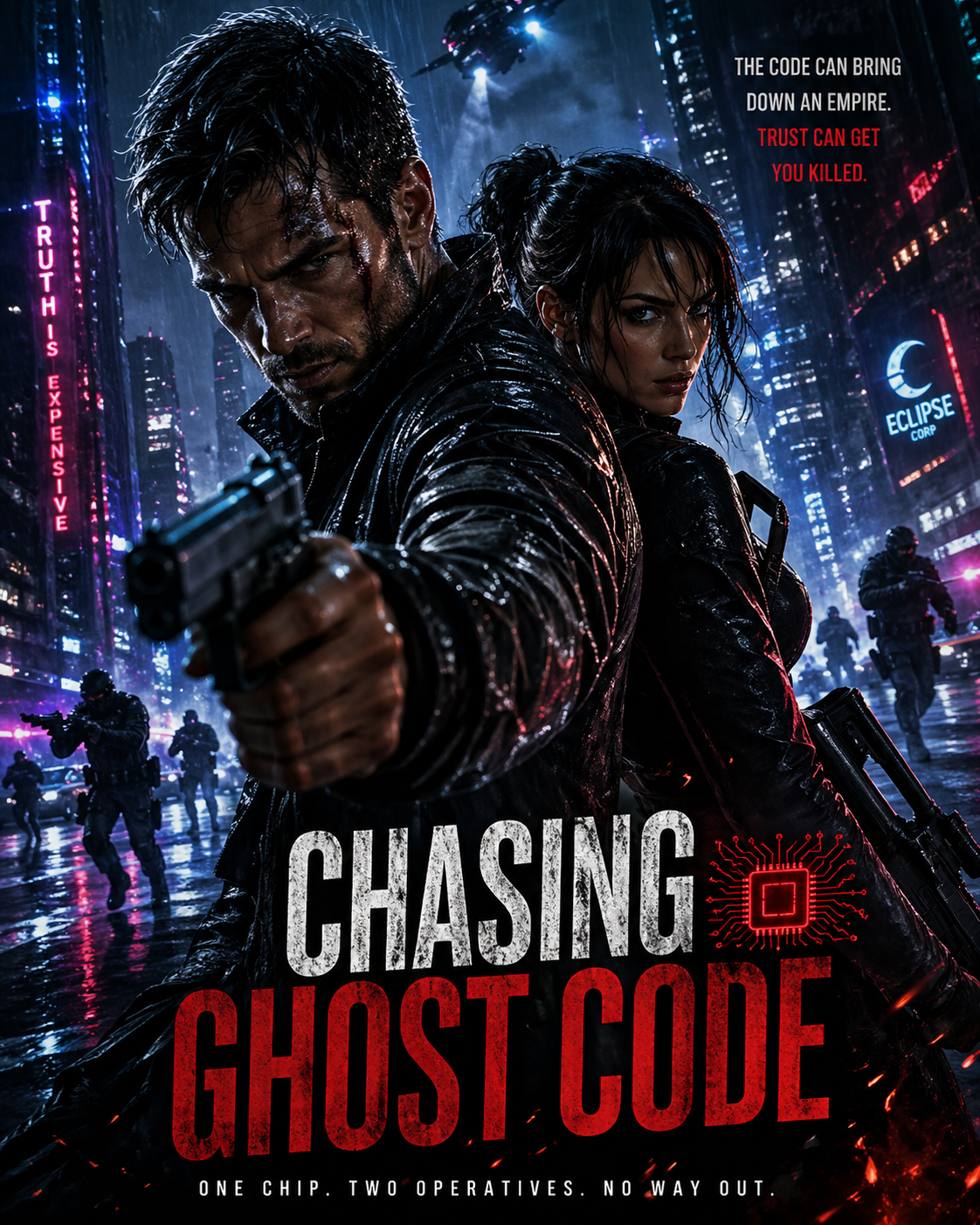
By night, it became something else entirely: a living circuit board of neon veins and rain-glossed steel, humming with secrets that pulsed behind every reflective surface. From the edge of a high rooftop, Jax watched it all breathe.

He had once belonged to it.
Now it felt like it was waiting to reclaim him.
Wind slid across the rooftop in cold sheets, tugging at his jacket as he stood motionless above the neon abyss. Somewhere below, sirens wailed and laughter spilled out of clubs like smoke. Somewhere deeper still, men with money and power were rewriting the rules of entire lives with a single encrypted file.
The data chip.
That was the reason he was back.
Officially, it didn’t exist. Unofficially, it could dismantle half the city’s elite network—banking, surveillance, arms trading, political leverage, everything built on layers of carefully engineered corruption. Whoever controlled it didn’t just hold leverage. They held extinction-level influence.
Jax exhaled slowly. He had promised himself he was done with this world. Done with wet work, double-crosses, and the kind of silence that followed gunfire.
But promises didn’t mean much in a city like this.
A soft chime in his earpiece broke the stillness.
“You’re late,” a woman’s voice said.
Zara.
Just hearing it tightened something in his chest—annoyance, recognition, something more complicated he refused to name.
“I wasn’t planning on coming back at all,” Jax replied.
“And yet here you are,” she said. “Standing on a rooftop like a cliché.”
He almost smiled.
Almost.
Then she added, “The chip moved again.”
That erased everything else.
Jax turned slightly, scanning the horizon. “Location?”
“Night district. Market corridor. Crowded. Perfect for disappearing.”
“Or ambushing.”
“Or both,” Zara said.
A pause stretched between them—thin, loaded, familiar.
They had once been partners. Not in any official sense. The kind of partnership built in smoke-filled extraction zones and escape routes measured in heartbeats. Then everything had gone wrong in a way neither of them ever fully explained.
Or forgave.
Now they were just two ghosts circling the same fire.
“Meet me there,” Zara said finally. “And try not to get nostalgic. It slows you down.”
The line went dead before he could respond.
Jax slipped into motion.
The night market was alive in a way that felt almost obscene.
Steam rose from food stalls, mixing with incense and exhaust. Vendors shouted over one another while holographic signs flickered above narrow alleys, advertising everything from synthetic memories to illegal augment upgrades. Bodies moved through it all—dense, careless, unaware of the silent war threading through their streets.
Jax moved like he belonged to none of it.
And everything of it.
He spotted the first anomaly within seconds: a man who wasn’t pretending to shop. Too still. Too focused. Eyes tracking movement rather than goods.
Then another.
Then two more.
Not locals.
Mercs.
His pulse shifted—not faster, just sharper.
A flicker of motion cut across his peripheral vision.
There.
A hooded figure slipping between stalls, carrying herself with a familiarity that hit him before he even confirmed it.
Zara.
And she was already running.
“Of course,” Jax muttered.
He moved.
The chase detonated instantly.
Stalls blurred past as he cut through the crowd, weaving between startled bodies and spilling trays of glowing street food. Shouts erupted behind him as the mercenaries reacted, pushing through the market like a breaking wave.
Zara didn’t look back once.
She never did.
Jax closed the distance just as she cut sharply into a narrow service alley between two decaying buildings. He followed, boots skidding slightly on wet concrete.
And then—
She stopped.
He almost collided with her.
The alley was tight, lit by a single flickering neon strip that painted everything in bruised violet light. Rain hissed softly somewhere above them.
Zara turned slowly.
Hood still up.
Eyes sharp.
“Still slow,” she said.
“You were running toward a dead end,” Jax replied.
“I was leading them.”
A beat.
Then footsteps echoed behind them. Multiple. Fast.
The mercenaries had followed cleanly.
Zara exhaled. “Still think too much.”
“Still don’t listen,” Jax shot back.
Then the first merc rounded the corner.
The alley erupted.
What followed wasn’t a fight so much as choreography under pressure.
Zara moved first—clean, economical, brutal in a way that suggested she had stopped hesitating a long time ago. One attacker went down before he fully raised his weapon. Jax caught the second’s arm mid-swing, redirected, and drove him into the wall hard enough to rattle loose piping.
Gunfire cracked.
Neon flickered.
Rain intensified.
They didn’t speak anymore.
There was no space for it.
Just movement.
Strike. Counter. Disarm. Redirect.
At one point, Zara landed against Jax’s shoulder to avoid a blade, and for half a second neither of them moved—too close, too aware, too many unspoken years compressed into a single breath.
Then she spun away and kicked someone into a dumpster.
“Focus,” she said.
“I am focused,” Jax replied.
“You’re remembering.”
That landed harder than any punch.
Still, they survived the alley.
Barely.
And ran again.
The abandoned warehouse was supposed to be safe.
It never was.
They slipped inside through a broken loading door, shadows swallowing them whole. Dust hung in the air like suspended time. Broken beams cut the space into fractured geometry. Somewhere water dripped in slow, patient rhythm.


Zara leaned against a rusted pillar, catching her breath.
Jax watched her for a moment longer than necessary.
“You planned the alley,” he said.
“I adapted,” she corrected.
“That’s a yes.”
A faint smirk touched her lips. “You’re still insufferable.”
“And you’re still terrible at honesty.”
The air between them tightened—not with tension alone, but with history. The kind that doesn’t dissolve cleanly. The kind that lingers in the way someone once stood too close during a gunfight and never fully stepped away afterward.
Then the warehouse doors exploded inward.
Gunfire flooded the space.
Time fractured again.
They ran deeper into the structure, vaulting over broken crates and slipping between collapsed scaffolding. Bullets carved light through dust clouds. Sparks erupted where metal met metal.
Zara grabbed Jax’s arm mid-sprint, yanking him into cover behind a concrete slab.
“Three teams,” she said quickly.
“Four,” Jax corrected, listening.
She looked at him.
He added, “There’s a sniper pattern above us. West beam.”
A pause.
“Still listening better than me,” she admitted.
“Still underestimating you,” he replied.
That earned a look—brief, sharp, unreadable.
Then they moved again.
Together.
Not as partners.
Not as enemies.
Something in between that didn’t have a name anymore.
They fought their way out through a shattered side exit, emerging into rain that hit like impact. The city opened around them again—alive, watching, waiting.
And then came the rooftops.
They climbed.
Jumped.
Ran along fire escapes that groaned under pressure.
Below them, the city pulsed like a heartbeat out of control.
At one point, Zara slipped slightly on wet metal. Jax caught her wrist without thinking.
For a second, neither let go.
Rain slid between them.
Neon reflected in her eyes.
“You always hesitate here,” she said quietly.
“I didn’t hesitate,” he replied.
“You did.”
The truth hung between them like a wire stretched too tight.
Then voices echoed below—pursuit closing in again.
Zara pulled free first.
Of course she did.
“Later,” she said.
“If there is a later,” Jax replied.
A faint, dangerous smile crossed her face. “There always is with you.”
Then she jumped.
The final confrontation came on a suspended skybridge between two towers, swaying slightly in the wind. Glass panels beneath them flickered with holographic ads that kept glitching under interference.
Mercenaries surrounded them from both ends.
Trapped.
Zara glanced at Jax. “Still think it’s just a retrieval?”
Jax shook his head once. “It never was.”
“Good,” she said softly. “Then we stop pretending.”
The first shot fired.
Then everything collapsed into motion.
They fought like memory and instinct fused together—Jax taking the front line, Zara slipping through gaps, exploiting angles, striking where attention couldn’t follow. Every movement was survival. Every breath cost something.
But even in chaos, they moved like they understood each other without speaking.
At one point, back-to-back, Zara said quietly, “You could’ve walked away again.”
“So could you.”
“I didn’t.”
A pause.
Then Jax said, “Neither did I.”
That was the closest thing to confession either of them allowed.
The fight ended the only way it could—sudden, violent, incomplete.
The chip was recovered.
But that wasn’t what either of them was really holding onto anymore.
After, the city felt quieter.
Not safer.
Just different.
They stood on the edge of the skybridge as dawn threatened the horizon, washing neon into pale memory.
Zara finally spoke.
“This doesn’t fix anything.”
“No,” Jax agreed.
“But it changes something,” she said.
He looked at her then—not as an operative, not as a weapon, not as a ghost from a life he’d abandoned.
Just as her.
“Yeah,” he said quietly. “It does.”
A long silence followed.
Then Zara stepped closer—not fully closing the distance, but close enough that the rain between them didn’t feel like separation anymore.
“You’ll disappear again,” she said.
“Probably.”
“And I’ll end up chasing something else dangerous.”
“Definitely.”
A faint smile.
Then, softer: “Same time next collapse?”
Jax almost laughed.
“Wouldn’t miss it.”
The city behind them roared back to life.
But for a brief moment—fragile, uncertain, real—they stood in the space between danger and something unspoken that felt dangerously close to hope.












 https://www.youtube.com/watch?si=RtToJsBhYBatUrym&v=mOuYNSdhjHA&feature=youtu.be